CARC LAB-2021. Between Mediums (online)
17 November – 10 December 2021
Curator Sasha Burkhanova-Khabadze
______________________________________________________________________________________________________________
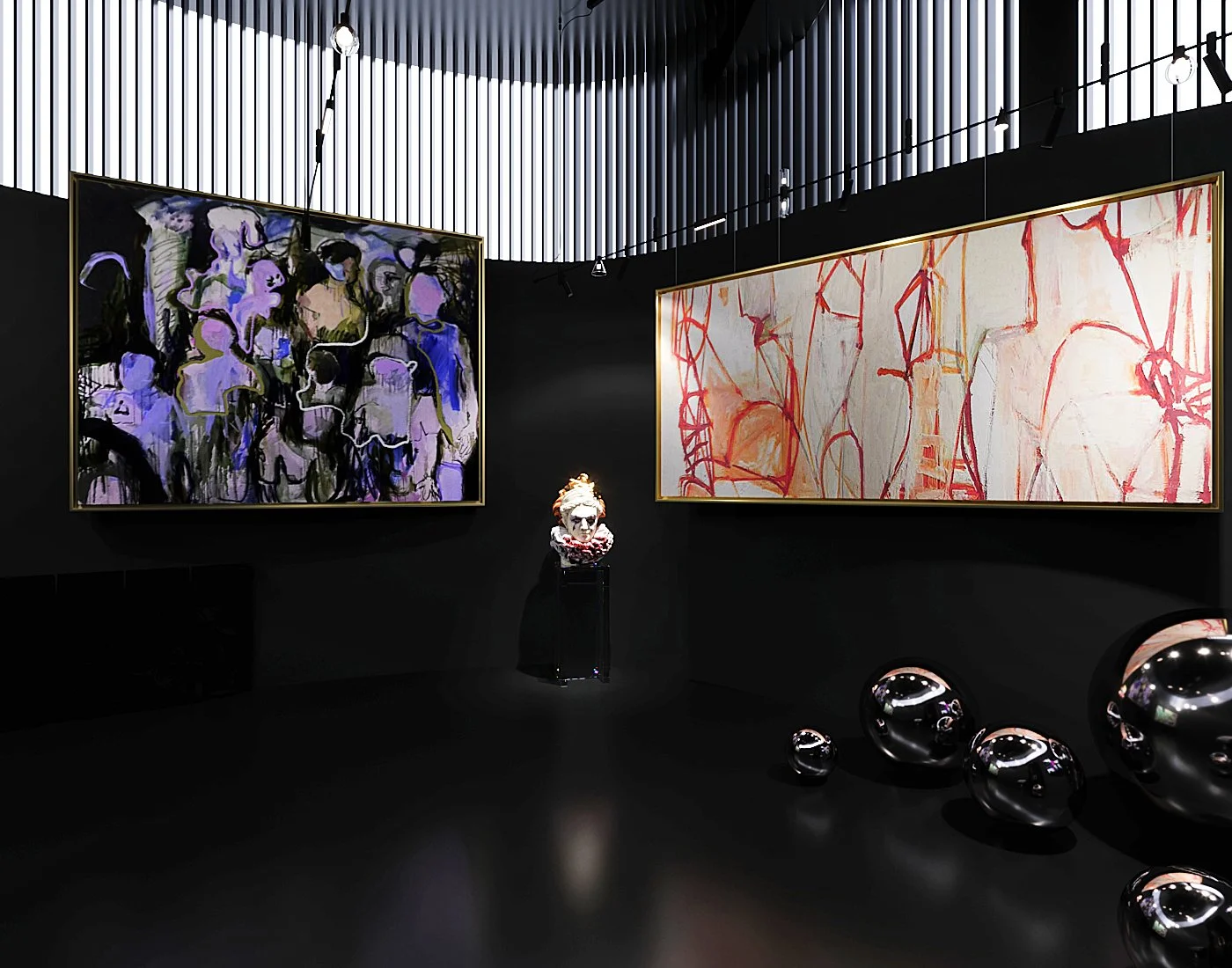
As the final chapter of CARC LAB/2021: Between Mediums brings together a group of artists whose practices move across painting, photography, sculpture, and installation. The exhibition explores image-making as a site of transformation, where material process, perception, and spatial experience converge. Set within Atticus Art Gallery’s immersive scenography, the exhibition unfolds as an environment of shifting surfaces, unstable forms, and heightened attention.
Rather than presenting medium as a fixed category, Between Mediums considers it as a condition of movement and exchange. Across the exhibition, images become sculptural, objects behave like afterimages, and material forms seem to hover between presence and disappearance. What emerges is a shared language of instability—one that asks how contemporary art might respond to fragmentation, visual overload, and the uncertainty of perception itself.
Isabelle Moreau
Isabelle Moreau’s sculptural work occupies a space between figuration and dissolution. Beginning with manipulated photographic imagery, she distorts facial structures before translating them into cast three-dimensional forms. The resulting busts appear suspended between apparition and ruin: unstable likenesses that resist fixity and suggest memory in the process of erosion. Their pale surfaces and softened contours produce a sense of psychological ambiguity, allowing the works to exist less as portraits than as material traces of disappearance. Within the exhibition, Moreau’s sculptures offer a quiet but powerful meditation on the fragility of identity and the instability of form.
Kai Ueda
Kai Ueda’s paintings occupy the threshold between gesture and interference. Built through layering, erasure, and painterly disruption, they evoke the visual logic of digital malfunction while remaining firmly rooted in the material language of paint. Their fractured surfaces suggest corrupted transmissions, interrupted signals, or fleeting moments of recognition that dissolve before they can fully take shape. Rather than offering visual certainty, Ueda’s works hold the viewer in a state of perceptual instability, transforming painting into a meditation on distortion, excess, and the difficulty of clarity in a technologically saturated world.
Javier Estévez
Javier Estévez expands photography into sculptural space. His layered glass constructions challenge the flatness traditionally associated with the photographic image, allowing light, depth, and reflection to become active components of the work. Images appear fractured, refracted, and spatially unstable, shifting in response to the viewer’s position. In these works, photography is no longer a transparent record of the world but a constructed and contingent visual field. Estévez’s use of layering and reflection produces an atmosphere in which perception itself becomes uncertain, inviting viewers to consider the image as something architectural, temporal, and materially complex.
Varvara Dmitrieva
Varvara Dmitrieva’s project explores how attention, perception, and identity are shaped by contemporary conditions of speed and visibility. At the centre of her presentation is a large-scale analogue photograph of a figure engulfed in leaves, suspended between stillness and movement. What initially appears as a pastoral image gradually unfolds as something more resistant and elusive. Working through analogue darkroom processes, Dmitrieva foregrounds slowness, physical labour, and the material conditions of image-making. Her vegetal and masked figures resist fixed legibility, inhabiting instead a space of transition and indeterminacy. Through grain, exposure, and chemical irregularity, her photographic surfaces retain the marks of their making, proposing a form of looking grounded in duration, opacity, and attentiveness.
Taken together, the works in Between Mediums propose the exhibition as a threshold rather than a conclusion. Each practice approaches material and image from a distinct position, yet all share an interest in instability, transformation, and the expanded possibilities of perception. The exhibition resists easy resolution, instead inviting viewers into a space of careful looking and embodied reflection. As the concluding instalment of CARC LAB/2021, Between Mediums affirms hybridity not as an aesthetic effect, but as a necessary condition for thinking and making in the present.
Curator
Sasha Burkhanova-Khabadze is the Director and Founder of Exposed Arts Projects in London (Company No. 11817453). She holds an MFA in Curating from Goldsmiths, University of London, and a PhD in Fine Art from Central Saint Martins, where she currently lectures on the Illustrating for Books course. With over a decade of experience in contemporary art and curatorial practice, Burkhanova-Khabadze has worked across exhibition-making, research, and critical writing, with projects presented at institutions in the United Kingdom, Switzerland, and Russia. Her writing has been published in Sleek, GARAGE, Interview, Moscow Art Magazine, and 1Granary. Founded in 2018, Exposed Arts Projects has developed as a platform for curatorial experimentation, critical dialogue, and support for emerging and established contemporary artists.